Why Working Harder Won't Scale Your Business (But Better Systems Will)
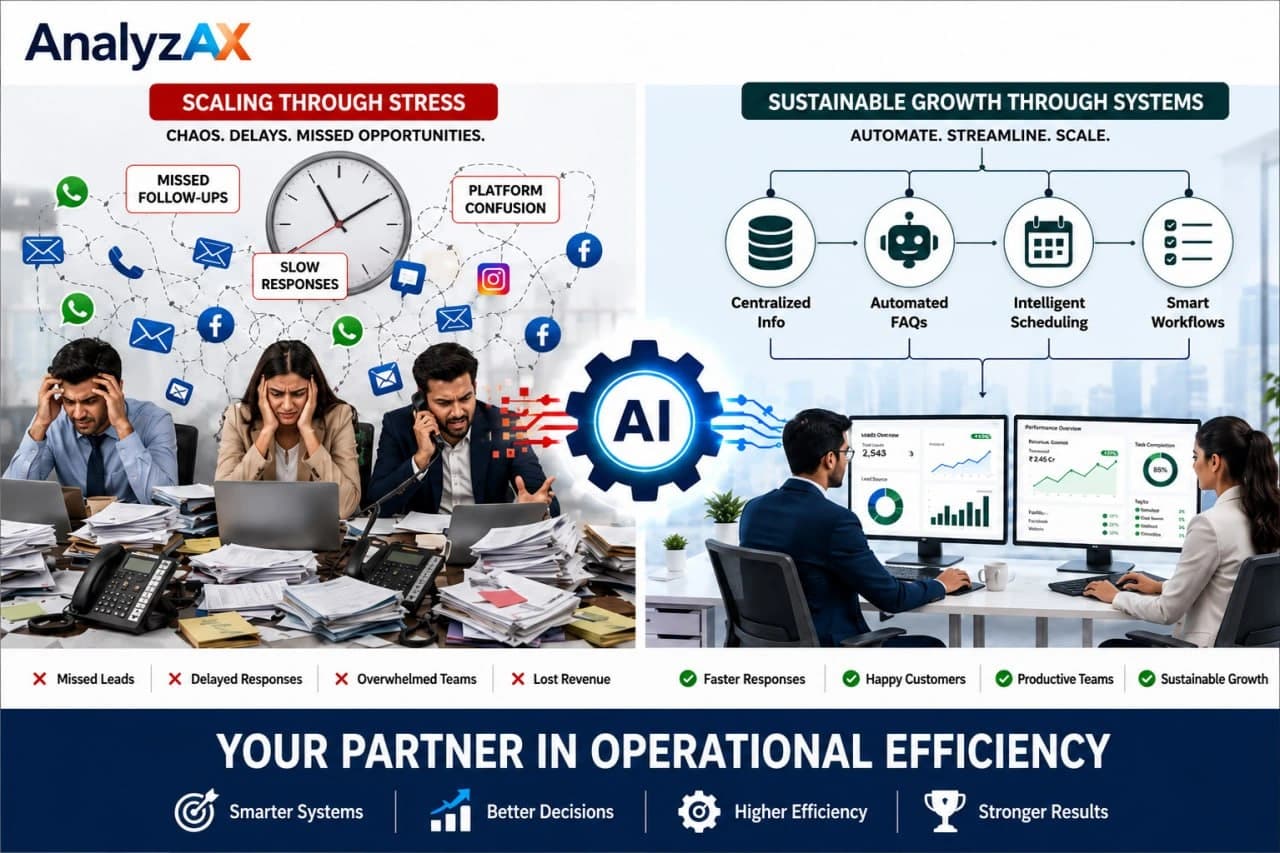
Most business owners work with a very basic assumption: if everyone is busy, the business must be growing. It is quite easy to understand why. If you look around the office floor, everyone seems totally occupied—attending calls, updating trackers, and rushing from one meeting to another. At first glance, all this hustle and bustle easily passes off as actual productivity.
The main issue is, all this running around eventually hits a roadblock. Even with the entire team working at full bandwidth, growth starts stagnating. Revenues flatline, deadlines are missed, and you are left with a highly burnt-out team. Meanwhile, the managers end up wasting half their day just doing rigorous follow-ups and tracking pending tasks. It forces you to ask a difficult question: if the entire team is working so hard, why does scaling up feel next to impossible?
The interesting part here is that the actual reason is almost invisible when you are caught up in the daily routine. We generally tend to confuse being occupied with making progress. But being busy and actually being productive are two very different things. A team can put in a full day's work without actually contributing to the company's growth. This usually happens when your resources get stuck in a loop of repetitive, manual grunt work that eats up all their time but does not add any core value to the business.
The Activity Illusion
This is exactly what AnalyzAX found when they took a look at a growing company that genuinely thought things were running smoothly. On paper, they were highly productive. The team was constantly engaged, customer data was being managed, and workflows were moving. There was never a lack of stuff to do.
But despite all that motion, they weren't growing at the pace they expected. Everyone was exhausted, and the operational pressure just kept dialing up every month. Naturally, the company figured they just needed more people, more managers, and more effort. But a deeper dive by AnalyzAX revealed something completely different.
While reviewing the current setup, someone brought up a critical point that totally shifted the focus of the meeting:
Ready to accelerate your growth?
See how AI automation can streamline your workflows and increase revenue with a step-by-step strategy.
If intelligent people spend most of their day doing work that doesn't require intelligence, what happens to the growth of the business?
On a day-to-day level, the answer seems simple enough. The work gets done. Emails go out, spreadsheets are updated, and boxes are checked. But stretch that out over time, and something much more damaging happens. People stop focusing on solving problems and just default to maintaining the machine. Creativity tanks. Innovation completely takes a back seat. You end up with your best resources stuck doing mundane, repetitive tasks, and the whole business becomes highly person-dependent for things that a basic software could easily automate.
The Real Bottleneck
When AnalyzAX really dug into this company's operations, they found employees burning hours manually typing in customer data, sending the exact same follow-up emails over and over, and acting as human bridges between disconnected software systems. It was all necessary work, sure. The root issue was that it was completely occupied their bandwidth, leaving them with no time to actually focus on the bigger vision.
It was a big surprise that they didn't have any shortage of staff. They had a broken process. If leadership had followed their gut and hired more people, they just would have paid more salaries to execute the same inefficient tasks. The company would have gotten bigger, but not any better. The underlying mess would have stayed completely untouched.
So, what actually happens when smart people do mindless work? Your growth stops being limited by market opportunities and starts being limited by your own internal processes. This company wasn't running out of customers or demand. They were just running completely out of operational efficiency.
Smarter Systems, Not Harder Work
To fix it, AnalyzAX didn't tell them to hire a bunch of new people or push the current team harder. Instead, they completely rewired how the work got done. They brought in intelligent automation to kill off the manual data entry. Systems were linked up, follow-ups triggered on their own, and reporting ran in the background without needing a human to babysit it. Things that used to eat up hours every day were suddenly just happening automatically.
Want a tailored AI roadmap?
Create your account and get personalized recommendations based on your business goals and current setup.
The results completely caught the leadership off guard. Suddenly, the team wasn't running around putting out fires all day, but the actual output was higher than ever. The usual chokepoints just cleared up on their own. No one was stuck with their endless paperwork, people actually got their time back to do meaningful, high-value work. The company finally stopped using sheer human effort to survive and let automated systems handle the daily grind.
It's worth knowing that is where there are many small and medium businesses get it wrong. They just assume scaling up requires people to work harder. But true, sustainable growth usually comes from stripping away unnecessary work altogether. You shouldn't be trying to max out human effort—you should be trying to max out efficiency.
Which brings us to the real question. Do you scale a business by making your people put in endless manual hours? Or does true expansion happen when you deploy systems that make all that daily grunt work completely irrelevant?
Top-tier companies realize one thing very early on: true scalability comes from setting up robust processes, not by constantly stretching the team's bandwidth. That's the exact shift AnalyzAX helps companies make. They don't replace your people; they just clear out the operational clutter so your talent can actually get back to doing what they do best—thinking, creating, solving problems, and driving the business forward.
Because the truth is, most companies don't have a talent problem.
They have a systems problem.
And most of them never even realize it until AnalyzAX points it out.
Written by AnalyzAX Team
AI Automation Expert
Discussion
Be the first to start the discussion.
Want to join the discussion? Log in to comment.